While walking and biking can work for a lot of individuals, some people still need a vehicle in their daily lives. An environmentally friendly vehicle is one that produces less harmful impacts to the environment than the comparable conventional vehicles. To go green with your vehicle choice consider these technologies:
(See below for a list of some of the top green vehicles today!)
Hybrid Technology
Conserving as much energy as possible, that is built up by the inertia of a moving car, is a major efficiency enjoyed by hybrid cars. This is accomplished through various technologies that are used in concert with a battery to utilize electricity in providing the energy demands of the car. While traditional gasoline is required for a significant portion of the vehicle’s operation, hybrid technologies like the Start-Stop system minimize its use by tapping into electrical power when the car’s needs are modest. Other processes like regenerative braking, take the traditionally discarded energy produced by a slowing car and store it in the battery for future use.
Quiet and effective at reducing fuel costs, hybrid technology is firmly entrenching itself as a reliable reducer of carbon emissions. The dependence on electric battery technology of specific makes of hybrid cars helps determine each model’s fuel efficiency rating. Recently the use of charging stations at various public places have enabled certain hybrid models, such as Nissan’s Leaf, Volvo’s V70 & Suzuki’s Swift, to maximize the contribution provided by a car’s battery. Depending on how diligently an owner is with keeping their battery juiced up, some owners are able to get by on one tank of gas a month for their daily commuting needs. Further advancements in hybrid technologies promise to trim the fuel needs of individual automobiles even further in the years to come.
Hydrogen
One promising technology that’s still in the development stage is the use of hydrogen as a propulsion source for automobiles. The explosive capability of hydrogen as fuel offers an alternative energy source that could cater to all of the car’s needs, while emitting only water as a by-product of its consumption. Much like fully electric cars, hydrogen cars need fuelling stations to provide them with ample hydrogen to meet their driving needs. The automotive industry is working hard to modernize hydrogen vehicles so that they are a practical consumer vehicle by 2015.
Flex Fuels
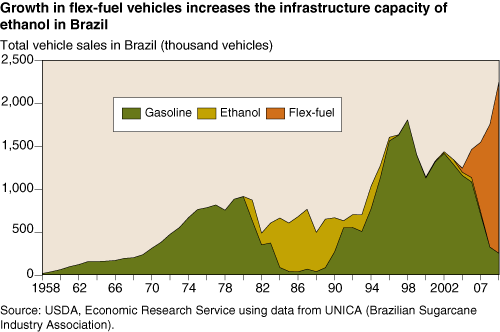
Flex fuels are derived from a mixture of traditional petroleum fuel with plant based ethanol, which greatly diminishes the carbon footprint that trails our global consumption of fuel. The E rating of a flex fuel denotes how much ethanol is in a particular grade of fuel which varies based on the availability of plant-based ethanol and the legal precedent in the region. For example, Brazil leads all countries with a government mandated minimum E20 rating for all commercial gas, while in the United States some corn belt states offer E85 fuel at a lesser cost than typical petroleum based gas.
The introduction of flex fuels into the automobile market has been great for and consumers alike, but there are still obstacles that limit its applicability. Low concentrations of ethanol can be tolerated by most typical car engines but when the content is significantly increased, damage or complete deterioration of the car’s engine can occur. Furthermore, flex fuels with a high ethanol concentration must be heated in cold climates before they can be put to use.
Initiatives
Setting the Tone with Car Share
 Founded in Australia’s second most populated city, Melbourne, Green Car Share is implementing one of the world’s most thorough car co-op coverage using an exclusively hybrid fleet of vehicles. Overwhelming support for the program has enabled the company to expand to Sydney and is waiting on approval to bring their service to nine other major Australian cities. Using Toyota’s Prius & Yaris as two of their predominant car share options allows those in the co-op to enjoy a fuel efficiency of under 5L/100km. Green Car Share understands the importance of removing swaths of carbon emissions through combining co-ops with hybrid technology and aims to have an entirely emissions free fleet by the year 2015.
Mass Transport through Hybrid Technology

Trailing only San Francisco as the greenest city in North America, Vancouver, BC, is home to a diverse set of companies that are pioneering methods of mass implementing hybrid technology across the lower mainland. Vancouver & its surrounding suburbs are supplied with its public transportation needs by Translink, a company that began utilizing hybrid technology in 2009 with the introduction of over 140 hybrid buses into their fleet. Employing hybrid technology reduces each bus’ particulate matter emissions to 2.5% of the amount produced by their predecessors. With most of the hybrid fleet serving Vancouver’s central transportation corridor, a significant proportion of the city’s residents are embracing hybrid technology in their daily commute.
Community Foundation Investing in Hybrid Co-Op

Toyota Prius V Plug-in Hybrid
Starting at $32,000
City Fuel Economy: 2.1L/100km
 This vehicle is ideal for people who are primarily travelling short distances at a low speed. This isn’t to say that the Prius V can’t accommodate long-distance driving or high speed driving, but utilizing the 4.4 kWh battery is optimal in city environments. Requiring about 2.5 – 3 hours to completely charge the battery produces enough energy to drive for approximately 24 kilometers on electricity alone. With impressive cargo space of over 34 cubic feetin this five seat hybrid, the Prius V is the perfect alternative family car.
Lincoln MKZ Hybrid
Starting at $41,400
Fuel Economy: 4.6 L/100km
Lincoln is making it easy for consumers to swap towards green energy by offering their MKZ hybrid model at the same price as the traditional model. Combining a 2.5-litre, four cylinder gas engine with a cutting edge electric engine provides customers with all the traditional power they are used to but with a quieter, less intrusive engine. Running on the electric engine alone, the MKZ is capable of reaching speeds of 47mph while assisting drivers with the SmartGauge with Eco Guide to help them optimize their fuel consumption.
Volkswagen Jetta Hybrid
To be released at the end of 2012
The Jetta promises to be one of the most fuel efficient hybrids in the market when it hits the streets at the end of 2012. Offering a 1.4-litre traditional engine that works in concert with a 20 kW electric engine, the Jetta can accommodate everybody’s driving style. With a chic seven-speed DSG dual-clutch transmission, the Jetta is the first of its kind to offer a light-weight automatic transmission vehicle for hybrid enthusiasts.
Honda Insight Hybrid
 Starting at $25,295
Fuel Economy: 4.8 Litres/100km
The five-door hatchback Insight has comparable specs to other hybrids in its class. It has been on the market since 2009 and can be found for under $20,000 in some economic climates, designating it an ideal choice for budgetary constrained environmentalists world round. The smooth drive provided by the 98 horsepower engine underneath the hood slides in low-emission hybrid technology without impacting its capabilities on the road.
Hyundai Sonata Hybrid
 Starting at $28,999
Fuel Economy: 4.6 Litres/100km
Hyundai illustrated its newest technological advancement, “Blue Drive Technology”, with its 2010 release the Sonata. A host of technological advances in the battery, shape, brakes & other areas, help the Sonata competitive with top hybrids in the market, despite its relatively spacious nature. For potential hybrid buyers who want the latest in typical gas-first hybrid technology, Hyundai’s Sonata is a viable option.
Ford Escape Hybrid
Starting at: $23,701
Fuel Economy: 5.8 Litres/100km
One of the longest established hybrids, the Escape provides a time-tested SUV hybrid option for consumers. While its fuel economy lags behind the competition, drivers of the Escape are impressed by how its power and durability compete with the rest of the compact SUV market. The escape employs a combination of an electric motor with a four-cylinder engine, which help it tackle the diverse environment of a four-wheel drive vehicle. For many green drivers, the Escape provides them with a sizable vehicle that will safely escort them into nature’s back-roads without major greenhouse gas emissions.
Nissan Leaf Electric Hybrid
 Starting at $38,395
Fuel Economy: 2.2 Litres/100km
Reaching where no hybrid has gone before, the Nissan Leaf’s 80 kW electric engine delivers the opportunity for drivers to eradicate fossil fuels from their transportation equation. Aside from its solely electrical nature,drivers of the Leaf get the most out ofalternative energy technology through features like a solar-panel spoiler on the rear and energy efficient LED lighting throughout the cars frame. The car’s battery can fuel it for upwards of 70 miles ofdriving, which together with its compact body and ability to comfortably seat five, make it an ideal car for city driving.
Chevy Volt Electric Hybrid
 Starting at $31,645
Fuel Economy: 2.5 Litres/100km
Unlike the comparable Nissan Leaf, the Chevy Volt provides a more gradual shift towards alternative energy, by endowing drivers with a gas tank to back up the electric motor. A fully charged battery will take drivers around 40 miles in electric mode with any other fuel needs provided by premium fuel, which places the vehicle’s fuel economy solely in the hands of its owners. The vehicle can be completely charged by a typical electrical outlet, making the Volt the most efficient hybrid choice in the market.
All price quotes are taken from corresponding company websites and are based on latest model specifications. For additional information, potential hybrid owners can visit used car dealerships for discounted options.
Thank you for taking the time to learn more about renewable energy - Knowledge Is Power! For more information go to www.endeavorscorp.com or write to us at info@endeavorscorp.com if you have questions or want to get involved. Have a green day!

 Vancouver's city planners are taking a page from the
imagination of one of the city's most celebrated writers. Douglas Coupland's V-Poles are conceptual
multipurpose poles of 12 feet or higher, that are equipped to bolster cellular
and wi-fi infrastructure, power electric cars wirelessly, process parking
transactions and display information via an LED display. The V-Pole (V standing for Vancouver) is an
efficient solution to urban utility clutter, and, according to Mayor Gregor
Robertson will enable “new generation communications, data and zero emission
transportation.”
Vancouver's city planners are taking a page from the
imagination of one of the city's most celebrated writers. Douglas Coupland's V-Poles are conceptual
multipurpose poles of 12 feet or higher, that are equipped to bolster cellular
and wi-fi infrastructure, power electric cars wirelessly, process parking
transactions and display information via an LED display. The V-Pole (V standing for Vancouver) is an
efficient solution to urban utility clutter, and, according to Mayor Gregor
Robertson will enable “new generation communications, data and zero emission
transportation.” 
 The technology for these does
not yet exist, however, the Vancouver Board of Parks and Recreation has approved a Telus proposal to build three monopoles in the West
End. A monopole is similar in concept to
Coupland's V-Pole. They are integrate
wireless improvements with electric car charging, but lack the wifi, parking
and signage features of the full V-pole. Coupland himself seems a little bit disappointed by the monopoles,
likening them to giant lint rollers over his twitter. Vancouver city council has passed a motion to
seek out pilot projects to develop full V-poles, so we can hope to see the full
technology in the next few years.
The technology for these does
not yet exist, however, the Vancouver Board of Parks and Recreation has approved a Telus proposal to build three monopoles in the West
End. A monopole is similar in concept to
Coupland's V-Pole. They are integrate
wireless improvements with electric car charging, but lack the wifi, parking
and signage features of the full V-pole. Coupland himself seems a little bit disappointed by the monopoles,
likening them to giant lint rollers over his twitter. Vancouver city council has passed a motion to
seek out pilot projects to develop full V-poles, so we can hope to see the full
technology in the next few years.