Showing posts with label Solar Power. Show all posts

Wednesday, 28 March 2012

African Solar Lanterns

"Evans Wadongo holds up one of his solar-powered LED lamps at his workshop in a Nairobi suburb. Not yet 25, Evans has already changed the lives of tens of thousands of his fellow Kenyans living in poor rural communities by supplying them with some 15,000 lamps since producing the first one from pieces of fabricated scrap metal and discarded solar equipment in 2004."

Africa spends roughly $10.5 billion on kerosene and candles for lighting purposes yearly - 70% of people are not connected to the power grid. Constant exposure to any type of fuel can be hazardous to a person's health, especially in developing countries where options are limited. Solar lanterns do not use kerosene, instead they utilize the energy from the sun which is plentiful in areas like Africa. The lanterns are environmentally friendly, provide 2 times the amount of light compared to kerosene lamps, and are designed to be used in a variety of environments. Read the full story of these amazing solar lanterns below or at physorg.com.


cempaka-africa

"As a child growing up in west Kenya, Wadongo struggled to do his homework by kerosene lamp. He was caned at school if his family ran out of fuel for the lamp, and he permanently damaged his eyesight by sitting over the smoky fumes when they did have kerosene.

But his father, whom he describes as a teacher who was "very strict" and "my greatest inspiration", saw that he completed his studies and made it into university.

Once there, Wadongo started wondering how to improve conditions for children in communities similar to his home village -- and there are many. Though Kenya is one of the richest countries in east Africa, more than half the population lives on less than a dollar a day.


The young man had always wanted to help people but did not have the stomach to go into medicine, so he opted for engineering. He was only 19 when he invented his first solar lamp after using part of his student loan to buy what he needed.

"Then, I never thought it would take off on this scale. I just wanted to take one to my grandma," he recalled.

Some 15,000 lamps have been turned out since production started in 2004, and Wadongo says his goal is to hit 100,000 by 2015.

"I started in the village where I grew up and I saw kids going from primary into high school," he told AFP.

He has no time for Kenya's political class, accusing them of "wanting people to remain poor so that they can stay in power".

For Wadongo, the lamps are not an end in themselves, but rather "a way to lift people out of poverty."

He and his team from the "Use Solar, Save Lives" project start by identifying impoverished communities that rely for lighting on kerosene lamps -- when they can afford the fuel. They hand out 30 lamps to a community association, often a women's group, and encourage the locality to pool the money each family has saved by no longer buying kerosene.

When the fund accumulates the group can use it for a project, such as fish farming or rabbit breeding. Nomadic communities get a special model of lamp for easier transport.

Typical is Chumbi village, some 50 kilometres (31 miles) outside Nairobi where Wadongo gets an enthusiastic welcome.

"They all want lamps," smiles Agnes Muthengi, a representative from a local association, the Kalima Kathei Women's Fellowship, who accompanied him to the village.


Jennifer David, 47, lives in a mud-brick house flanked by outbuildings made largely from scrap metal. Next door, a field of maize wilts for lack of water. David's husband is a casual day labourer and work is hard to come by. Her only other source of income is a fledgling rabbit breeding business. But with one rabbit only fetching the equivalent of one euro ($1.3) locally and one of the five children sick and in a home, life is a struggle.

A slogan painted on rusted corrugated iron informs the visitor that the inhabitants "trust in Jesus". Hanging on a post in the yard, one of Wadongo's lamps is charging.

"Since I got this lamp things have changed," David told AFP. "Before I was using kerosene. It smelled and gave off a lot of smoke and I was using a lot of money to buy the kerosene." Now, her children can read and study in the evening, without cost or nuisance.


Wadongo plans to extend his project to neighbouring countries -- Uganda is next on the list. He is already training interns, not only from Kenya and elsewhere in Africa but also from US universities. He also aims to decentralise production of the lamps, thus providing work for unemployed youths.

The young engineer is also planning a "model" village at Nyaobe in the west of this country, which straddles the equator. Residents will be hooked up to a local solar-powered grid and will have access to Internet.

"If every one of us started thinking about others before thinking about ourselves the world would be better," he says. 


Jennifer David, 47, hangs her solar-lamp outside her mud-brick house to get some sunlight at Chumbi village, some 50 kilometres southeast of Nairobi. David says the lamp has changed her family's life. Now, her children can read and study in the evening, without cost or nuisance.

A villager at Chumbi village, some 50 kilometres southeast of Nairobi, reads with the aid of a solar-powered lamp in her house. She is among the villagers in the east African country who have benfited from solar-powered LED lamps innovated by Kenyan Evans Wadongo.

(c) 2011 AFP physorg.com"


To learn more about the advantages of solar lanterns watch this short video on our YouTube channel!

Thank you for taking the time to learn more about renewable energy - Knowledge Is Power! For more information go to www.endeavorscorp.com or write to us at info@endeavorscorp.com if you have questions or want to get involved. Have a green day! 

Friday, 16 March 2012

Sun in the Forecast for the Developing World’s Alternative Energy

Green energy for all

Green Launches
The developed world, once thought to be the dominant employer of green technology, is slowly being met in renewable energy investment by the developing world. Thanks to the emerging middle classes in the densely populated regions of China and India, a desperate need for expansive power networks is bringing alternative energy into the picture. In addition, many of the world’s impoverished citizens live outside the reach of urban grids forcing them to rely on inefficient and hazardous energy sources like coal and kerosene. Thankfully, renewable energy’s capability to provide localized, safe, reliable, and inexpensive power is catapulting it to the front of charitable agendas worldwide.

Green Alliance
Additionally, extensions of government initiatives for renewable energy investments and international campaigns, such as the UN’s dedication to making 2012 “The International Year of Sustainable Energy for All”, promise to surge investment in renewable projects in the developing world for years to come. While the significant investments in green technology undertaken by major developing nations have provided a beacon of hope for our planet and its residents’ viability, a spotlight must shine in the coming years on the poverty ridden nations of our globe.


Declining prices

Economies of scale and the technological improvement of solar panels have given renewable energy comparable advantages in key characteristics with the leaders of its industry. Thanks to the plunging prices of photovoltaic (PV) units, which have dipped more than 60% in the past three years, solar energy is providing some of the highest returns on energy investment in the world’s sunny regions.


Why rural

Since an ample supply of solar energy is commonly found in the poverty stricken regions in Africa, Southeast Asia, and Latin America, PV technology is a logical candidate in eliminating global energy poverty. Besides the geographical fit solar panels have with impoverished nations, PV units also boast advantages of being small-scale, remotely implemented, and completely emission free. Whereas other renewables like hydro or biomass require substantial financing, strategic placing, and minimization of the environmental impact, solar panels face little, if any, of these obstacles. As over 80% of those without electricity are in the rural areas of our planet, the assets provided by PV technology in bringing remote, cost-effective energy directly to people, will help shed light on global poverty.


Desertec

The most promising project in the Africa/Eastern European region is being offered by the blossoming renewable energy group Desertec, which is devoted to completely satiating energy needs with the immense power of the sun. Using solar panels in an expansive network stretching across the Saharan Desert from Saudi Arabia to Morocco, the projects aim is to source enough electricity to supply the entire region with enough left over to supply 15% of the continental European demand. The first solar farm in the Desertec project will be installed in Morocco later in 2012, with many more to follow.


Micro-financing enables low income investment

Aside from Africa, there is a pulsating need for affordable, reliable electricity in Asian and Latin American nations living below the poverty line. Whether it’s the over 400 million people living without electricity in booming India or the 20 million living off the grid in war torn Afghanistan, the need for energy is pressing. Micro-financing has opened an entire world of possibility to the poor through social enterprises like Kiva, an interest free collection of first world lenders who donate funds to third world lenders via the Internet.

The benefit of renewable energy is so promising that entrepreneurs are investing in third world projects not just for the humanitarian benefit, but for the reliable return garnered from their investment. For example, the Cambodian based company Kamworks offers rental prices on alternative energy units that match the daily cost of kerosene. This makes the investment in renewables affordable for those living in poverty and rewards investors with increasing returns, as their start-up costs are paid off with rental fees. Over the next decade, the expansion of micro-financing options that bring individual renewable energy units, particularly solar, to remote locations will provide light in every corner of the globe.

Opportunity for growth

Beyond Profit
Despite record levels of financial growth in 2011 to Africa’s green energy sector, which more than tripled its 2009 level of financial investment, the renewable abundance of energy in Africa remains largely untapped and dramatically lagging behind the rest of the world. Over $3.6 billion was invested across the sun-baked continent in 2009, with most of it shelled out to northern and southern African nations. Contrast this figure with the $211 billion posted by the market as a whole and it becomes evident that Africa is tragically under serviced in its renewable potential. The encouraging news is that over the past three calendar years, African investment continues to reach new record levels, inspiring confidence in investors to get behind life-changing alternative energy projects.

Renewable Energy Law
The advantage provided by lacking infrastructure in developing nations has been reflected in the steady growth of the developing world’s investment in renewable technologies in the early 2000s. With options like micro-financing becoming a practical option for some of the poorest people on the earth, the basic right to electricity has been given a vehicle for mass delivery. Furthermore, collective widespread investments in far-reaching green projects will whittle away the dependence on fossil fuels while providing much needed employment and income opportunities for our poorest nations. The coming years will be prosperous ones for the green industry in the developing world, as all of the steam built up by the previous decades investment will propel change throughout the third world.


Thank you for taking the time to learn more about renewable energy - Knowledge Is Power! For more information go to www.endeavorscorp.com or write to us at info@endeavorscorp.com if you have questions or want to get involved. Have a green day! 


Monday, 12 March 2012

Solar Success: How Companies Are Making Solar Power Affordable

Of all the available renewable energies solar power is currently one of the easiest to harness on an individual level, you can even by solar chargers and lights at places like Home Depot! Solar panels can be utilized even under cloudy skies, although energy production generally dips down to 50%, and can produce as little as 10% on an extremely overcast day. Naturally, it is most efficient in areas where there are the large amounts of direct sunlight. With companies like Eight19 finding ways to keep costs low and develop efficient off-grid modules, solar power is shaping up to be a conceivable way of bringing electricity to many rural areas.


Rural Solar

  
Eight19 takes its name from the time it takes sunlight to reach the earth - 8 minutes and 19 seconds. Its mission is to develop the technologies and manufacturing processes that will bring off-grid solar power to a new generation of users, transforming lives and accelerating economic development. Today, there are 1.6Bn people in the world without electricity. The majority live in the world’s most economically deprived communities, where the up-front cost of solar power is unaffordable. Eight19’s printed plastic solar technology is designed to deliver flexible, lightweight, robust and lower cost solar cells for a variety of solar-powered applications.
  
Eight19 is able to keep manufacturing costs down by using printed plastic, a technology originally developed at Cambridge University. This produces affordable, lightweight, and durable solar cells.

For under-developed countries such as Africa, it is important to utilize technology that does not require significant infrastructure like electrical grids. Eight19 developed IndiGo, a solar lighting and battery-charging system that works like a pay-as-you-go mobile account.

The company recently completed a trial run among a approximately 200 rural Kenyan families. For a $10 deposit, Eight19 loaned to a family a solar cell that generates 2.5 watts of electricity. According to Eight19, when fully activated, this is enough power to light two small rooms and charge a cell phone for seven hours.

To use the module the families had to buy scratch cards, for approximately one dollar, which have specific PINs that must be texted to Eight19. Once families have bought approximately $80 worth of scratch cards, they have paid off the solar cell and now own it. After this initial investment, the families are free to use the solar cells forever.

$10 deposit = 1 solar cell generating 2.5 watts electricity
(fully activated = 2 small rooms and 1 cell phone for 7 hours)

+ (80 x $1 scratch cards) = $90
= solar power for life

Eight19 also offers an option to trade in for a larger cell through the IndiGo Energy Escalator.


See more solar success stories here at Restoring the Power.

Thank you for taking the time to learn more about renewable energy - Knowledge Is Power! For more information go to www.endeavorscorp.com or write to us at info@endeavorscorp.com if you have questions or want to get involved. Have a green day! 


Thursday, 9 February 2012

Solar Energy in the Home

We can all play our individual part in an effort to be greener and this starts in the home. Oil and gas cause pollution and are not an infinite source of energy; we have to look at other options and renewable energy is the way forward. By taking advantage of renewable energy sources like solar energy, we help reduce our carbon footprint as well as save money in the long run. There are a number of solar renewable energy options which can be used around the home for generating electricity, heating/ cooling and hot water.

Paula from Ireland tells us her own experience of using solar heating panels in her own home:

“My parents decided to have solar panels installed into their home after learning that the Irish government was offering grants to encourage people to use renewable energy.  My parents are environmentally conscious but they also saw solar heating as a way of saving money and relying less on commercial energy like oil or gas. Oil was used to heat it the house before but oil prices were getting more expensive. The benefits of solar heating have been extensive, and I have noticed these differences first hand. Ireland has quite a wet climate and so cloudy overcast days are a regular sight. However, water (for the central heating system, showers and sinks) can still be heated even on a dull overcast day. Even if it is only 10 or 15 Degrees Celsius outside, the temperature of the water in the solar panels can be over 45 degrees).
My uncle had done a course on installing solar panels and so the solar panels were set up on our garage roof which is south facing and gets direct sunlight all day. The cylinder for storing the water was also set up in the garage and underground pipes were laid which connect the cylinder to the house.
My parents have noticed a big difference to their oil bill especially throughout the summer months when oil isn’t needed at all. The days are longer and brighter and so reliance on commercial energy was greatly reduced. My parents find that the solar heating provides enough hot water to heat the home as well as provide hot showers for everyone. My parents can also choose when and how they would like to use the warm water. Just think how even more beneficial solar heating would be if you live in a country where there is a lot more annual sunshine and seasons are far less variable! Not only are my parents saving money but they have reduced their reliance on energy like oil or gas which are harmful to the environment and cause global warming. According to the Sustainable Energy Authority of Ireland, active solar heating systems can provide economical hot water and space heating. In Ireland , solar panels can provide around 60% of the annual hot water requirements for homes and buildings. In fact, one square metre receives the equivalent of more than 100 litres of oil in free solar energy per year!

  
Generating Electricity

Photovoltaic (PV) Solar Panels

This is the using solar panels at in the home to generate electricity. It is also known as photovoltaic systems. The amount of power from the sun that reaches the earth at noon on a clear day is about 1,000 Watts per square meter. This is roughly enough power for the electricity needs of a medium sized house. PV systems convert sunlight directly to electricity.

How it works

Solar panels are made from thin layers of semiconductor material, typically silicon. The solar panels work any time the sun is shining. Unlike solar thermal systems for heating water, PV does not use the sun's heat to make electricity. When radiation from the sun shines on this material it generates electrical power. Electronics are then used to adjust the voltage to the correct level. PV allows you to produce electricity—without noise or air pollution—from a clean, renewable resource.


If you generate more power than you use there are two options for what to do with the excess. You can use batteries to store it or, in the UK for example you can sell excess power to the main electricity grid, you will be paid for this.And of course you'll also save money on your electricity bill, because you'll be using your own electricity. This is known as the feed-in tariff.  Wind turbines are also eligible for the UK’s feed-in tariff. In fact, Wind resources are strongest in the winter months, while solar resources are stronger in the summer months, so this means that these two energy sources actually work well together and are often used in hybrid systems.

In warmer countries, the suns energy can actually be used for cooling in homes. Photovoltaic panels can be used to generate electricity to run air conditioning units. During the summer when the sun's intensity is the strongest, it makes sense to harness that power and use it for cooling.

Solar Lighting

A great idea for around your garden is solar lighting. Solar lighting is used for garden lighting, pathway lighting, and architectural lighting as well as for Christmas lighting. For all those who enjoy decorating their homes with Christmas lights, solar Christmas lights would be a great option for next Christmas. There are many perks to solar lighting:

No energy bills so you save money! No wiring so they don’t need a power outlet nearby. No noise or pollution. They are easy to install!


How it works

These solar lights use a mini photovoltaic solar cell which converts solar energy into electricity which is stored in a rechargeable battery. Then at night time, the photo resistor sends out a signal to the controller that it is dark. The controller then routes the power from the battery to the LED in order to turn it on and produce light.

It is important to place solar lighting in locations that receive plenty of sunlight. Lights will also need to be positioned so that the photo resistors aren't near a bright light source in order to make sure the LEDs turn on when the Sun sets.

Heating / Cooling and Hot Water

Solar Thermal Panels

A completely different option is solar thermal panels. These do not generate electricity. Instead, the solar panels heat up the water thus reducing the need to use electricity or gas for heating/ cooling or to heat water. It converts both direct and indirect sunlight into heat so it works even when the sky is overcast. There are two components involved in solar heating: the solar panels and the storage cylinder.

How it works

Cold water is stored in the cylindor and this cold water is then pumped through the solar panels. The sun then heats the solar panels and this heats the water. Then the hot water is pumped back into the tankand then around the home.Hot water naturally rises within the tank so there is no need for pumps
The warm water can then be used for hot water, showers and to heat radiators.

Solar thermal panels can also be used for cooling within the home. Cooling is primarily used in commercial settings, but it is becoming more common in residential homes. There are two applications suitable for residential settings where solar thermal energy is used to drive the cooling process.

Solar Absorption Cooling uses solar-heated water to drive an air conditioner. The air conditioner uses a liquid that consists of an absorbent and a refrigerant. At room temperature these two liquids mix well together. Then solar heat is used to separate the absorbent and the refrigerant from each other. The refrigerant is then compressed and evaporated to create a cooling effect for your home. The evaporated refrigerant is then recombined with the absorbent to go through the process again.

Solar Desiccant Cooling doesn't really cool the air, it removes moisture from the air which decreases the relative humidity. The moisture is removed by passing the air through a material called a desiccant. As the desiccant absorbs the moisture from the air, it becomes saturated and loses its ability to continue absorbing moisture. At this point, the desiccant is then regenerated, or dried, with solar heat which evaporates the moisture into the outside air. It is then ready to absorb more moisture from the air entering your home.


Passive Solar Design for Heating and Cooling

Passive Solar Design is a way of designing a house in orderto minimize or maximize the impact the summer sun has on your home. Passive solar design refers to the orientation and building design of a house.

Summer and Winter

By building a southerly facing house and with the majority of the windows on the south facing wall and the minimum amount on the north facing wall we can maximize solar potential. Keeping non heated or less heated rooms like bathrooms to the back of the house will act like a buffer zone. This means more sunlight and heat, which means less need for lighting and heating. Making these decisions when designing a house can reduce energy bills by 10%.

It is important not to have too many windows though or overheating can occur especially in the spring and summer. Generally, opening windows should be enough to get rid of excess heat in the house. Excess heat gains from the sun can also be avoided by shading windows with blinds or overhangs etc. These overhangs shade the house in the summer months but will allow the sunlight to enter the house in the winter months when the sun is lower in the sky.

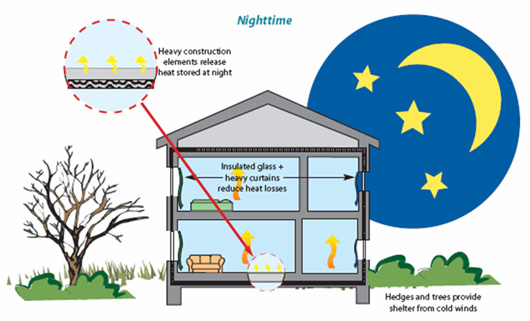
Additional measures like extra insulation (which stores heat during the day and releases heat at night) and high energy performing windows / doors help trap heat and keep the home warm. The types of plants surrounding our home also play a huge part. Shrubbery can be used for shelter and protection against wind. Deciduous trees are also very beneficial because the provide shade in the summer and in the winter months, they lose their leaves meaning that the house is exposed to sun. These additional measures mean that savings can be trebled.


Cooling

In hot, humid climates, Passive Solar Cooling is a great option. So instead of trying to achieve maximum solar potential, the aim is to make a house as cool as possible. Passive cooling uses passive solar design principles to reduce or eliminate your home's need for mechanical cooling systems. By incorporating passive solar design principles into your home's design and landscaping, your home will be naturally comfortable and you will have lower energy bills. The following steps help to keep the house cool.

Orienting your home is important to minimize the amount of sunlight that hits it during the hot summer and to take advantage of the prevailing breezes. In order to keep a house cool, the north facing wall should have the most windows and the south facing wall should only have small windows set high in the wall.

Plant shrubbery around the home for shading. Create pathways throughout the home for natural ventilation. Insulate your home to maintain a comfortable temperature.Have a roof that is lighter in colour, well insulated, and equipped with proper ventilation to exhaust acquired heat. Build an overhang over windows, deep enough to block out the sun in the very hot summer months.


Thank you for taking the time to learn more about renewable energy - Knowledge Is Power! For more information go to www.endeavorscorp.com or write to us at info@endeavorscorp.com if you have questions or want to get involved. Have a green day! 


Thursday, 22 December 2011

Global Investment in Renewable Energy: India

India is next on our list of countries with the largest reported investments in renewable energy in 2010.


India has a vast supply of renewable energy resources, and it has one of the largest programs in the world for deploying renewable energy products and systems. It is the only country in the world to have an exclusive ministry for renewable energy development, the Ministry of Non-Conventional Energy Sources (MNES). Since its formation, the Ministry has launched one of the world’s largest and most ambitious programs on renewable energy.


Policies


Here are a few of India’s renewable energy policy plans (click for more information):
Foreign Investment Policy – Foreign investors can enter into a joint venture with an Indian partner for financial and/or technical collaboration and for setting up of RE-based power generation projects.
Industrial Policy – A five-year tax holiday is allowed for renewable energy power generation projects.
Soft loans are available through Indian Renewable Energy Development Agency for renewable energy equipment manufacturing.

Private sector companies can set up enterprises to operate as licensee or generating companies.


Motives

 
India’s energy consumption has been increasing at one of the fastest rates in the world due to population growth and economic development.

Primary commercial energy demand grew at the rate of 6% between 1981 and 2001.


Renewable Energy Availability

India is surpassed only by Germany as one of the world's fastest growing markets for wind energy.
India has an average annual temperature that ranges from 25°C – 27.5 °C. This means that India has huge solar potential.
In India, small hydro (less than 25 megawatts) is the most utilized renewable energy source for energy production. 
Click here for more details.


Stay tuned for more countries coming up!
Thank you for taking the time to learn more about renewable energy - Knowledge Is Power! For more information go to www.endeavorscorp.com or write to us at info@endeavorscorp.com if you have questions or want to get involved. Have a green day!
Sources: GENINRIIndia Energy PortalAsian Correspondent,Bloomberg New Energy Finance and United Nations Environment Programme (2011)