Showing posts with label Renovation. Show all posts

Tuesday, 6 March 2012

Geothermal Energy in the Home

Geothermal energy means energy derived from the heat within the earth. People have made use of geothermal energy in the form of hot springs for centuries (i.e. the ancient romans used geothermal energy to heat their baths), however, the first attempt to generate electricity from this energy source did not occur until the 20th century.

The production of electricity from geothermal energy sources can be a highly efficient means of delivering clean and renewable electricity to many people. Location is of key importance for the development of an efficient geothermal power station and therefore, economically viable levels of electricity can only be generated in certain areas of the world. Currently geothermal power heats 89% of the houses in Iceland and over 54% of the primary energy used in Iceland comes from geothermal sources. However, there are only a handful of locations across the world that are capable of producing viable and efficient levels of electricity from geothermal energy sources and as a result of this, in 2007, less than 1% of the world's electricity supply was produced from geothermal sources.

Generating electricity from geothermal energy requires an industrial system which is by no means suitable for a home. An alternative means of harnessing geothermal energy in a bid to receive a source of clean and renewable energy is through a ground source heat pump. This is a environmentally friendly way to heat your home and heat water.

Heat pumps

Throughout the year, almost 50% of the sun’s energy is absorbed into the earth where it maintains a consistent temperature just a few feet below the ground’s surface. Geothermal heat pumps consist of two parts: a circuit of underground piping outside the house, and a heat pump unit inside the house. These systems can either be an open loop system or a closed loop system.

Closed loop systems are when the same fluid (usually water and anti-freeze) always flows through the collector pipes. In a closed-loop system, a loop is buried horizontally or drilled vertically in the earth around the home, or laid in a nearby lake or pond.

Open loop systems draw well water for use as the heat source or heat sink, and after use, return the well water to a drainage field or another well. New water is always being pumped through the system when it is in operation. It is called an open-loop system because the ground water is open to the environment.


A ground-source heat pump uses the earth or ground water or both as the sources of heat in the winter, and as the "sink" for heat removed from the home in the summer. This combination of high performance technology allows us to tap into the earth’s natural heating and cooling properties to consistently and evenly distribute warm or cool air in your home throughout each season. 

Using a heat pump alone to may not meet your full heating / cooling needs.  Unlike gas and oil boilers, heat pumps deliver heat at lower temperatures over much longer periods. You will notice that radiators won't feel as hot to the touch as they might do when you are using a gas or oil boiler. During the winter they may need to be on constantly to heat your home efficiently. However, used in conjunction with a supplementary form of heating, such as an oil, gas or electric furnace, a heat pump can provide reliable and economic heating in winter and cooling in summer.

If you already have an oil or electric heating system, installing a heat pump may be an effective way to reduce your energy costs. Heat pump systems can also be used in conjunction with under floor heating. Under floor heating is an ideal distribution system because high temperatures are not required (the larger the surface area discharging heat, the lower the temperature needs to be). Under floor heating uses a large mass of concrete (your floor) to store the heat, and this storage effect means the heat pump will not cycle (frequently switch on and off) which can shorten the life of the unit. 

The main advantage of geothermal ground source heat pumps is that they can be used in many locations. Even ground source heat pumps installed in colder regions such as Norway and Sweden see significant results. A geothermal heat pump system can be highly effective at reducing the energy you require to heat water and therefore reducing your energy bills. While residential geothermal heat pump systems are usually more expensive initially to install than other heating and cooling systems, their greater efficiency means the investment can be recouped in two to seven years. After that, energy and maintenance costs are much less than conventional heating and air-conditioning systems.

How it works

Heat pump systems are typically made up of the following main components: 

Collector (system used to collect heat from the surroundings)
Heat pump unit and associated components
Heat distribution system (under floor heating or equivalent low temperature distribution system)
Control system (weather compensation, thermostats, timers etc.)

Heat pumps don’t make electricity but reduce the need for electricity for heating and cooling. They move hot water from the ground outside into the house.

A heat pump is an electrical device that extracts heat from one place and transfers it to another. The heat pump is not a new technology; it has been used in Canada and around the world for decades. Refrigerators and air conditioners are both common examples of this technology. 

The geothermal heat pumps consist of two heat exchanger coils. A substance called a refrigerant carries the heat from one area to another. When compressed, it is a high temperature, high pressure liquid. If it is allowed to expand, it turns into a low temperature, low pressure gas. The gas then absorbs the heat. In one coil, the refrigerant is evaporated at low pressure and absorbs heat from its surroundings. The refrigerant is then compressed en route to the other coil, where it condenses at high pressure. At this point, it releases the heat it absorbed earlier in the cycle. This is how we heat the home and heat water for showers etc. All heat pumps have an outdoor unit (called the condenser) and an indoor unit (an evaporator coil).


The heating cycle
 
Heat from the ground is absorbed at low temperatures into a fluid inside a loop of pipe (a ground loop) buried underground. The fluid then passes through a compressor that raises it to a higher temperature, which can then heat water for the heating and hot water circuits (showers) of the house. The cooled ground-loop fluid passes back into the ground where it absorbs further energy from the ground in a continuous process as long as heating is required.


The cooling cycle

The cooling cycle is basically the reverse of the heating cycle. The direction of the refrigerant flow is changed by the reversing valve. The refrigerant picks up heat from the house air and transfers it directly, in DX systems, or to the ground water or antifreeze mixture. The heat is then pumped outside, into a water body or return well (in an open system) or into the underground piping (in a closed loop system). Refrigerators and air conditioners are both examples of heat pumps operating only in the cooling mode.

Different types of geothermal pumps

Geothermal heat pump systems are usually not do-it-yourself projects. To ensure good results, the piping should be installed by professionals who follow procedures established by the International Ground Source Heat Pump Association (IGSHPA). Designing the system also calls for professional expertise: the length of the loop depends upon a number of factors, including the type of loop configuration used; your home’s heating and air conditioning load; local soil conditions and landscaping; and the severity of your climate. Larger homes requiring more heating or air conditioning generally need larger loops than smaller homes. Homes in climates where temperatures are extreme also generally require larger loops. The type of soil around your home is also an important factor. The following are a list of the different geothermal pump options.

Closed loop systems

Horizontal Loops
Horizontal loops are the most common type of loop system, and are commonly used in home where an adequate land surface is available     (rural areas). An excavator will dig several trenches about six feet deep in the ground, each one up to 300 feet long. Our green geothermal pipe is placed in the trenches which are then backfilled with soil.

Vertical Loops
Vertical loops are primarily used in areas with a limited land surface area (urban areas). A specially designed geothermal drilling rig bores vertical holes into the ground each ranging from 180 to 540 feet deep. Our green geothermal pipe is inserted into each vertical bore and then the holes are filled with bentonite grout.

Pond or Lake Loops
On properties that have a nearby lake or pond that is appropriate in size and eight feet deep, a loop system can be submerged at the bottom of the body of water. A single trench is excavated from the home to the water and typically two pipes are inserted into it. These two pipes connect to several green geothermal pipes that are submerged at the bottom of the lake or pond. This type of loop design may be the most economical when a home is near a body of water such as a shallow pond or lake. Fluid circulates underwater through polyethylene piping in a closed system, just as it does through ground loops. The pipes may be coiled in a slinky shape to fit more of it into a given amount of space. Since it is a closed system, it results in no adverse impacts on the aquatic system.

Open loop systems

Open Loops
Open loops are most commonly used on rural properties that have existing high capacity water wells. Ground water is withdrawn from an aquifer through a supply well and pumped into the heat pump, while discharged water from the heat pump is redirected into a second well and back into the same aquifer.


Could geothermal work for you

In 2010 Maurice Stanley wrote a thesis titled “An analysis of the viability of geothermal heating in residential housing in Ireland” and as part of his research he conducted a literature review, case study, and also sent out a questionnaire to 11 people who use geothermal energy in their homes.
He discovered from his research that the average cost for using geothermal heating for one year averaged under half of the price of oil heating. His case study suggests a payback period of just over 7.5 years, while his questionnaire responses suggest an average payback period of 10 years; with some systems having a life span of nearly 25 years the savings which can be made are very reassuring.

Over all the results from the questionnaire were very positive with a massive 82% of geothermal heat users were happy with their systems. 46% of the users would not even consider switching from their geothermal system. This positive result points out that the majority of people who rely on ground source heat pumps for their heating needs are pleased with the chosen method of heating.

He also discovered that out of the eleven users questioned, only two use complementary heating systems namely in the form of a gas boiler and a wood pellet stove. This result demonstrates that the majority of users of geothermal heating systems do not require any additional heat source. According to this, the ground source heat pumps seem to be a sufficient way of heating a home in Ireland.
From the primary sources of information gathered by the author it is clear that such heating systems are economically viable and an excellent solution for domestic home heating in Ireland, and potentially many other locations as well!

For information about other renewable energies in your home please visit our articles on Solar Energy, Wind Energyand stay tuned for more!


Thank you for taking the time to learn more about renewable energy - Knowledge Is Power! For more information go to www.endeavorscorp.com or write to us at info@endeavorscorp.com if you have questions or want to get involved. Have a green day! 

Sources: Geosmart EnergyEnergy Saving TrustGeothermal-heat-pump-resourceSEAIConsumer Energy CenterNRCANClean-energy-ideasCANGEAGeothermal_energyRenewable_energy_in_IcelandGeothermal Int“An analysis of the viability of geothermal heating in residential housing in Ireland” by Maurice Stanley, BSc (Hons) Quantity Surveying, Edinburgh Napier University

Thursday, 9 February 2012

Solar Energy in the Home

We can all play our individual part in an effort to be greener and this starts in the home. Oil and gas cause pollution and are not an infinite source of energy; we have to look at other options and renewable energy is the way forward. By taking advantage of renewable energy sources like solar energy, we help reduce our carbon footprint as well as save money in the long run. There are a number of solar renewable energy options which can be used around the home for generating electricity, heating/ cooling and hot water.

Paula from Ireland tells us her own experience of using solar heating panels in her own home:

“My parents decided to have solar panels installed into their home after learning that the Irish government was offering grants to encourage people to use renewable energy.  My parents are environmentally conscious but they also saw solar heating as a way of saving money and relying less on commercial energy like oil or gas. Oil was used to heat it the house before but oil prices were getting more expensive. The benefits of solar heating have been extensive, and I have noticed these differences first hand. Ireland has quite a wet climate and so cloudy overcast days are a regular sight. However, water (for the central heating system, showers and sinks) can still be heated even on a dull overcast day. Even if it is only 10 or 15 Degrees Celsius outside, the temperature of the water in the solar panels can be over 45 degrees).
My uncle had done a course on installing solar panels and so the solar panels were set up on our garage roof which is south facing and gets direct sunlight all day. The cylinder for storing the water was also set up in the garage and underground pipes were laid which connect the cylinder to the house.
My parents have noticed a big difference to their oil bill especially throughout the summer months when oil isn’t needed at all. The days are longer and brighter and so reliance on commercial energy was greatly reduced. My parents find that the solar heating provides enough hot water to heat the home as well as provide hot showers for everyone. My parents can also choose when and how they would like to use the warm water. Just think how even more beneficial solar heating would be if you live in a country where there is a lot more annual sunshine and seasons are far less variable! Not only are my parents saving money but they have reduced their reliance on energy like oil or gas which are harmful to the environment and cause global warming. According to the Sustainable Energy Authority of Ireland, active solar heating systems can provide economical hot water and space heating. In Ireland , solar panels can provide around 60% of the annual hot water requirements for homes and buildings. In fact, one square metre receives the equivalent of more than 100 litres of oil in free solar energy per year!

  
Generating Electricity

Photovoltaic (PV) Solar Panels

This is the using solar panels at in the home to generate electricity. It is also known as photovoltaic systems. The amount of power from the sun that reaches the earth at noon on a clear day is about 1,000 Watts per square meter. This is roughly enough power for the electricity needs of a medium sized house. PV systems convert sunlight directly to electricity.

How it works

Solar panels are made from thin layers of semiconductor material, typically silicon. The solar panels work any time the sun is shining. Unlike solar thermal systems for heating water, PV does not use the sun's heat to make electricity. When radiation from the sun shines on this material it generates electrical power. Electronics are then used to adjust the voltage to the correct level. PV allows you to produce electricity—without noise or air pollution—from a clean, renewable resource.


If you generate more power than you use there are two options for what to do with the excess. You can use batteries to store it or, in the UK for example you can sell excess power to the main electricity grid, you will be paid for this.And of course you'll also save money on your electricity bill, because you'll be using your own electricity. This is known as the feed-in tariff.  Wind turbines are also eligible for the UK’s feed-in tariff. In fact, Wind resources are strongest in the winter months, while solar resources are stronger in the summer months, so this means that these two energy sources actually work well together and are often used in hybrid systems.

In warmer countries, the suns energy can actually be used for cooling in homes. Photovoltaic panels can be used to generate electricity to run air conditioning units. During the summer when the sun's intensity is the strongest, it makes sense to harness that power and use it for cooling.

Solar Lighting

A great idea for around your garden is solar lighting. Solar lighting is used for garden lighting, pathway lighting, and architectural lighting as well as for Christmas lighting. For all those who enjoy decorating their homes with Christmas lights, solar Christmas lights would be a great option for next Christmas. There are many perks to solar lighting:

No energy bills so you save money! No wiring so they don’t need a power outlet nearby. No noise or pollution. They are easy to install!


How it works

These solar lights use a mini photovoltaic solar cell which converts solar energy into electricity which is stored in a rechargeable battery. Then at night time, the photo resistor sends out a signal to the controller that it is dark. The controller then routes the power from the battery to the LED in order to turn it on and produce light.

It is important to place solar lighting in locations that receive plenty of sunlight. Lights will also need to be positioned so that the photo resistors aren't near a bright light source in order to make sure the LEDs turn on when the Sun sets.

Heating / Cooling and Hot Water

Solar Thermal Panels

A completely different option is solar thermal panels. These do not generate electricity. Instead, the solar panels heat up the water thus reducing the need to use electricity or gas for heating/ cooling or to heat water. It converts both direct and indirect sunlight into heat so it works even when the sky is overcast. There are two components involved in solar heating: the solar panels and the storage cylinder.

How it works

Cold water is stored in the cylindor and this cold water is then pumped through the solar panels. The sun then heats the solar panels and this heats the water. Then the hot water is pumped back into the tankand then around the home.Hot water naturally rises within the tank so there is no need for pumps
The warm water can then be used for hot water, showers and to heat radiators.

Solar thermal panels can also be used for cooling within the home. Cooling is primarily used in commercial settings, but it is becoming more common in residential homes. There are two applications suitable for residential settings where solar thermal energy is used to drive the cooling process.

Solar Absorption Cooling uses solar-heated water to drive an air conditioner. The air conditioner uses a liquid that consists of an absorbent and a refrigerant. At room temperature these two liquids mix well together. Then solar heat is used to separate the absorbent and the refrigerant from each other. The refrigerant is then compressed and evaporated to create a cooling effect for your home. The evaporated refrigerant is then recombined with the absorbent to go through the process again.

Solar Desiccant Cooling doesn't really cool the air, it removes moisture from the air which decreases the relative humidity. The moisture is removed by passing the air through a material called a desiccant. As the desiccant absorbs the moisture from the air, it becomes saturated and loses its ability to continue absorbing moisture. At this point, the desiccant is then regenerated, or dried, with solar heat which evaporates the moisture into the outside air. It is then ready to absorb more moisture from the air entering your home.


Passive Solar Design for Heating and Cooling

Passive Solar Design is a way of designing a house in orderto minimize or maximize the impact the summer sun has on your home. Passive solar design refers to the orientation and building design of a house.

Summer and Winter

By building a southerly facing house and with the majority of the windows on the south facing wall and the minimum amount on the north facing wall we can maximize solar potential. Keeping non heated or less heated rooms like bathrooms to the back of the house will act like a buffer zone. This means more sunlight and heat, which means less need for lighting and heating. Making these decisions when designing a house can reduce energy bills by 10%.

It is important not to have too many windows though or overheating can occur especially in the spring and summer. Generally, opening windows should be enough to get rid of excess heat in the house. Excess heat gains from the sun can also be avoided by shading windows with blinds or overhangs etc. These overhangs shade the house in the summer months but will allow the sunlight to enter the house in the winter months when the sun is lower in the sky.

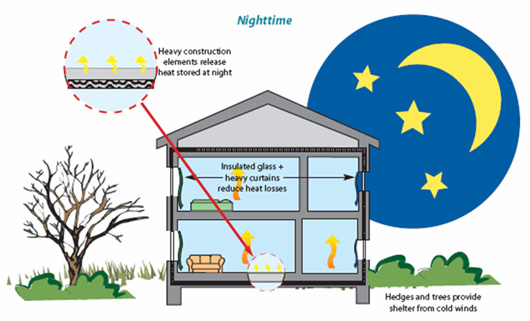
Additional measures like extra insulation (which stores heat during the day and releases heat at night) and high energy performing windows / doors help trap heat and keep the home warm. The types of plants surrounding our home also play a huge part. Shrubbery can be used for shelter and protection against wind. Deciduous trees are also very beneficial because the provide shade in the summer and in the winter months, they lose their leaves meaning that the house is exposed to sun. These additional measures mean that savings can be trebled.


Cooling

In hot, humid climates, Passive Solar Cooling is a great option. So instead of trying to achieve maximum solar potential, the aim is to make a house as cool as possible. Passive cooling uses passive solar design principles to reduce or eliminate your home's need for mechanical cooling systems. By incorporating passive solar design principles into your home's design and landscaping, your home will be naturally comfortable and you will have lower energy bills. The following steps help to keep the house cool.

Orienting your home is important to minimize the amount of sunlight that hits it during the hot summer and to take advantage of the prevailing breezes. In order to keep a house cool, the north facing wall should have the most windows and the south facing wall should only have small windows set high in the wall.

Plant shrubbery around the home for shading. Create pathways throughout the home for natural ventilation. Insulate your home to maintain a comfortable temperature.Have a roof that is lighter in colour, well insulated, and equipped with proper ventilation to exhaust acquired heat. Build an overhang over windows, deep enough to block out the sun in the very hot summer months.


Thank you for taking the time to learn more about renewable energy - Knowledge Is Power! For more information go to www.endeavorscorp.com or write to us at info@endeavorscorp.com if you have questions or want to get involved. Have a green day! 


Thursday, 24 November 2011

Geothermal Heating Systems

When most people think of geothermal energy they envision mega-structures, financed by substantial investments, so that they can penetrate deep into the earth’s interior and tap into the bubbling energy that lies underneath the surface. 

Sustainable engineers have found a way to scale down these huge geothermal operations with a geoexchange heat system, which dives into the ground around a homeowner’s property to create a highway of energy transportation between a house and the ground.


Ranging from $5,000 to $20,000, depending on the size and installation demands of particular buildings, consumers around the world are being introduced to the highly efficient system, which warms a facility in the winter and cools it in the summer.


The system’s fundamental operating principle hinges on the fact that the temperature in the ground below us consistently ranges between ten and sixteen degrees Celsius. This narrow range, coupled with the wider scope of temperatures found on the surface, serves as a depository for excess heat in the warm summers and a bank of heat supply in cold winters.  Unlike other renewable energy sources which face the challenge of inconsistent energy supplies, geoexchange is a method that provides a dependable flow of energy at any location across the globe.


The financial benefit of running a 2,000 square foot home in the North American Pacific Northwest with geoexchange heat would save over $1,000, not to mention the 6 tonnes of greenhouse gas emissions that are kept out of our atmosphere thanks to the system.  

Bigger buildings derive an even higher level of efficiency from these systems allowing investors to pay off the initial installation costs in as little as three years. While some sites may be more challenging than others to dig down in to, engineers are able to accommodate the geological and geometric constraints of each situation to find a way to access the energy below the crust.


The efficiency of geoexchange heating systems pays off to owners in their pocket and their contribution to their environment, which ensures that it will become a pillar of energy supply for years to come.

Thank you for taking the time to learn more about renewable energy - Knowledge Is Power! For more information go to www.endeavorscorp.com or write to us at info@endeavorscorp.com if you have questions or want to get involved. Have a green day!