Showing posts with label Home Energy. Show all posts

Monday, 20 February 2012

Wind Energy in the Home

Wind energy is a power that has been harnessed for centuries and calls to mind familiar images of wind mills throughout the world. Today power companies use the wind's energy to generate electricity, but how can you use it? Installing your own personal wind turbine is a green way of generating your own electricity; it is clean, renewable, and produces no greenhouse gases.

Factors to Consider when Buying a Wind Turbine

Wind Speed

Before getting a wind turbine it is important to check the wind speed in your area. To do this, one should refer to wind maps and wind data in their region. Even if the wind data for your location is promising, a hill or other barrier might not be accounted for which would result in wind speeds being greatly reduced. 

There is a great wind speed prediction tool on the www.energysavingtrust.org.uk website whereby you can enter your postcode and state whether your home is urban or rural. The website can then tell you whether your home is in a suitable location for building a wind turbine.

Wind turbines are very site specific. If wind speeds are below par, then your wind turbine will not produce enough electricity. Wind speeds should be above 18km (10mph) in order for the turbine to generate enough electricity.

Surroundings

The wind speed itself is dependent on a number of factors such as:
- Location (houses built along the coast or on wide open plains are in an ideal location to consider having a wind turbine)
- Nearby obstructions such as buildings and trees
- Height of the turbine above ground level or on top of your roof.

Turbulence

Smaller turbines are susceptible to turbulence, so if you live near to a busy road, or near trees, or in a built up area, a wind turbine is unlikely to work well for you. Turbulent air - where the wind is constantly changing direction - leaves the turbines constantly changing direction, constantly chasing the wind rather than extracting power from it. This is why it is important to build your wind turbine up high because the higher the turbine, the stronger the wind. Also by building your turbine up high, it prevents wind energy from being obstructed. Turbines can be set up either on a pole or on the roof of a house.

Types of Home Turbines

Building Mounted 

Building mounted turbines are smaller systems that can be installed on the roof of a home where there is a suitable wind resource. Often these are around 1kW to 2kW in size. This type of wind turbine is more suited to someone who lives in a residential area. These turbines must be located in exposed areas where wind energy is high. If there are trees or any buildings nearby, then they will cause obstructions which affect the wind speed. The turbine will need to be high enough off the roof so that it will not be affected by turbulence from the roof.

Pole Mounted

Pole mounted turbines are free standing and are erected in a suitably exposed position, often around 5kW to 6kW. Pole mounted turbines are particularly ideal for a person who lives on a large property. It is important that these pole mounted turbines are built high and away from obstructions like buildings or trees. For obvious reasons, this type of wind turbine is not really suitable for someone who lives in an urban residential area.

Building-mounted turbines tend to produce less electricity per kW than pole-mounted ones. A well-sited 6kW turbine can generate approximately 10,000 kWh per year.

In many countries wind turbines require planning permission and there are a number of criteria that a wind turbine will need to meet. If you decide to get a turbine there are many grants and a lot of do-it-yourself (DIY) information on the internet.

If a wind turbine is not right for your home, you can always harness the wind's energy by using it to dry your clothes. Using a dryer can use up a lot of electricity and is not cost effective so why not take advantage of this great energy source!

How Wind Turbines Work

A wind turbine works the opposite of a fan: instead of using electricity to make wind, wind turbines use wind to make electricity. Wind turbines use large blades to catch the wind. When the wind blows, the blades are forced round, driving a turbine which generates electricity. The wind turbine collects kinetic energy from the wind which is then converted into electricity by magnets moving past a stator (stationary part of a rotor system). As the magnets pass the stator, alternating current (AC) electricity is produced. It is then converted into direct current (DC) electricity which can be used to charge the batteries that store the electrical energy or can also be fed into the electricity grid.


Small wind energy systems can be connected to the electricity distribution system. These are called grid-connected systems. A grid-connected wind turbine can reduce your consumption of utility-supplied electricity for lighting, appliances, and electric heat. You can also get stand-alone wind turbines which are not connected to the grid.

Stand-alone turbines: In remote locations, stand-alone systems can be more cost-effective than extending a power line to the electricity grid. But these systems are also used by people who live near the grid and wish to obtain independence from the power provider or demonstrate a commitment to non-polluting energy sources. The stand-alone system uses batteries which store electricity for use during times that your system is not producing electricity due to resource unavailability.


Grid connected turbines: When the turbine cannot deliver the amount of energy you need, the utility makes up the difference. That way the grid can switch between wind energy and the utility company.Grid connected wind turbine will operate only when the utility grid is available. During power outages, the wind turbine is required to shut down due to safety concerns.In some countries like the UK, when the home is linked with the grid any surplus electricity that is produced by the turbine, can be sold to the utility company to reduce and sometimes even eliminate your electric bill. This is known as the feed in tariff.


The stronger the wind, the more electricity produced. Wind is variable and can change day to day so in one day your wind turbine may produce enough electricity to run your house. During periods with not enough wind, the home is supplied power from the utility company or in the case of stand-alone turbines, a battery (with stored electricity) is used. 

Wind resources are strongest in the winter months, while solar resources are stronger in the summer months, so this means that these two energy sources actually work well together and are often used in hybrid systems. A person can switch between the two energy sources. On a cloudy day, a turbine will still produce electricity and on a sunny calm day solar panels will produce electricity.

Sizes of Wind Turbines

Large – these large industrial turbines produce hundreds of megawatts of electricity (expressed as “MW”) and are used by utility companies. Large turbines are usually installed in reserved places called wind farms.

Small – these are ideal for homes, small farms or a small business. They produce no more than 100 kilowatts (KW) of electricity and can be used as a back-up power supply or to decrease energy consumption.

Very small – these turbines are used to charge batteries of a large number of recreational vehicles like small boats.

Homeowners would usually use a small home wind turbine. There are also two types of wind turbines available: horizontal axis and vertical axis. The horizontal axis type comes with a tower, the vertical ones are usually anchored to the ground.

The horizontal axis turbine is the most common and is installed so that it aims directly at the wind. It has a component called a tailvane that will point the turbine to the direction of the wind. The vertical axis type can be installed in whichever way the wind blows, but it needs more ground space to accommodate the wires and other components.


For information about other renewable energies in your home please visit our article on Solar Energy and stay tuned for more!


Thank you for taking the time to learn more about renewable energy - Knowledge Is Power! For more information go to www.endeavorscorp.com or write to us at info@endeavorscorp.com if you have questions or want to get involved. Have a green day! 

Thursday, 9 February 2012

Solar Energy in the Home

We can all play our individual part in an effort to be greener and this starts in the home. Oil and gas cause pollution and are not an infinite source of energy; we have to look at other options and renewable energy is the way forward. By taking advantage of renewable energy sources like solar energy, we help reduce our carbon footprint as well as save money in the long run. There are a number of solar renewable energy options which can be used around the home for generating electricity, heating/ cooling and hot water.

Paula from Ireland tells us her own experience of using solar heating panels in her own home:

“My parents decided to have solar panels installed into their home after learning that the Irish government was offering grants to encourage people to use renewable energy.  My parents are environmentally conscious but they also saw solar heating as a way of saving money and relying less on commercial energy like oil or gas. Oil was used to heat it the house before but oil prices were getting more expensive. The benefits of solar heating have been extensive, and I have noticed these differences first hand. Ireland has quite a wet climate and so cloudy overcast days are a regular sight. However, water (for the central heating system, showers and sinks) can still be heated even on a dull overcast day. Even if it is only 10 or 15 Degrees Celsius outside, the temperature of the water in the solar panels can be over 45 degrees).
My uncle had done a course on installing solar panels and so the solar panels were set up on our garage roof which is south facing and gets direct sunlight all day. The cylinder for storing the water was also set up in the garage and underground pipes were laid which connect the cylinder to the house.
My parents have noticed a big difference to their oil bill especially throughout the summer months when oil isn’t needed at all. The days are longer and brighter and so reliance on commercial energy was greatly reduced. My parents find that the solar heating provides enough hot water to heat the home as well as provide hot showers for everyone. My parents can also choose when and how they would like to use the warm water. Just think how even more beneficial solar heating would be if you live in a country where there is a lot more annual sunshine and seasons are far less variable! Not only are my parents saving money but they have reduced their reliance on energy like oil or gas which are harmful to the environment and cause global warming. According to the Sustainable Energy Authority of Ireland, active solar heating systems can provide economical hot water and space heating. In Ireland , solar panels can provide around 60% of the annual hot water requirements for homes and buildings. In fact, one square metre receives the equivalent of more than 100 litres of oil in free solar energy per year!

  
Generating Electricity

Photovoltaic (PV) Solar Panels

This is the using solar panels at in the home to generate electricity. It is also known as photovoltaic systems. The amount of power from the sun that reaches the earth at noon on a clear day is about 1,000 Watts per square meter. This is roughly enough power for the electricity needs of a medium sized house. PV systems convert sunlight directly to electricity.

How it works

Solar panels are made from thin layers of semiconductor material, typically silicon. The solar panels work any time the sun is shining. Unlike solar thermal systems for heating water, PV does not use the sun's heat to make electricity. When radiation from the sun shines on this material it generates electrical power. Electronics are then used to adjust the voltage to the correct level. PV allows you to produce electricity—without noise or air pollution—from a clean, renewable resource.


If you generate more power than you use there are two options for what to do with the excess. You can use batteries to store it or, in the UK for example you can sell excess power to the main electricity grid, you will be paid for this.And of course you'll also save money on your electricity bill, because you'll be using your own electricity. This is known as the feed-in tariff.  Wind turbines are also eligible for the UK’s feed-in tariff. In fact, Wind resources are strongest in the winter months, while solar resources are stronger in the summer months, so this means that these two energy sources actually work well together and are often used in hybrid systems.

In warmer countries, the suns energy can actually be used for cooling in homes. Photovoltaic panels can be used to generate electricity to run air conditioning units. During the summer when the sun's intensity is the strongest, it makes sense to harness that power and use it for cooling.

Solar Lighting

A great idea for around your garden is solar lighting. Solar lighting is used for garden lighting, pathway lighting, and architectural lighting as well as for Christmas lighting. For all those who enjoy decorating their homes with Christmas lights, solar Christmas lights would be a great option for next Christmas. There are many perks to solar lighting:

No energy bills so you save money! No wiring so they don’t need a power outlet nearby. No noise or pollution. They are easy to install!


How it works

These solar lights use a mini photovoltaic solar cell which converts solar energy into electricity which is stored in a rechargeable battery. Then at night time, the photo resistor sends out a signal to the controller that it is dark. The controller then routes the power from the battery to the LED in order to turn it on and produce light.

It is important to place solar lighting in locations that receive plenty of sunlight. Lights will also need to be positioned so that the photo resistors aren't near a bright light source in order to make sure the LEDs turn on when the Sun sets.

Heating / Cooling and Hot Water

Solar Thermal Panels

A completely different option is solar thermal panels. These do not generate electricity. Instead, the solar panels heat up the water thus reducing the need to use electricity or gas for heating/ cooling or to heat water. It converts both direct and indirect sunlight into heat so it works even when the sky is overcast. There are two components involved in solar heating: the solar panels and the storage cylinder.

How it works

Cold water is stored in the cylindor and this cold water is then pumped through the solar panels. The sun then heats the solar panels and this heats the water. Then the hot water is pumped back into the tankand then around the home.Hot water naturally rises within the tank so there is no need for pumps
The warm water can then be used for hot water, showers and to heat radiators.

Solar thermal panels can also be used for cooling within the home. Cooling is primarily used in commercial settings, but it is becoming more common in residential homes. There are two applications suitable for residential settings where solar thermal energy is used to drive the cooling process.

Solar Absorption Cooling uses solar-heated water to drive an air conditioner. The air conditioner uses a liquid that consists of an absorbent and a refrigerant. At room temperature these two liquids mix well together. Then solar heat is used to separate the absorbent and the refrigerant from each other. The refrigerant is then compressed and evaporated to create a cooling effect for your home. The evaporated refrigerant is then recombined with the absorbent to go through the process again.

Solar Desiccant Cooling doesn't really cool the air, it removes moisture from the air which decreases the relative humidity. The moisture is removed by passing the air through a material called a desiccant. As the desiccant absorbs the moisture from the air, it becomes saturated and loses its ability to continue absorbing moisture. At this point, the desiccant is then regenerated, or dried, with solar heat which evaporates the moisture into the outside air. It is then ready to absorb more moisture from the air entering your home.


Passive Solar Design for Heating and Cooling

Passive Solar Design is a way of designing a house in orderto minimize or maximize the impact the summer sun has on your home. Passive solar design refers to the orientation and building design of a house.

Summer and Winter

By building a southerly facing house and with the majority of the windows on the south facing wall and the minimum amount on the north facing wall we can maximize solar potential. Keeping non heated or less heated rooms like bathrooms to the back of the house will act like a buffer zone. This means more sunlight and heat, which means less need for lighting and heating. Making these decisions when designing a house can reduce energy bills by 10%.

It is important not to have too many windows though or overheating can occur especially in the spring and summer. Generally, opening windows should be enough to get rid of excess heat in the house. Excess heat gains from the sun can also be avoided by shading windows with blinds or overhangs etc. These overhangs shade the house in the summer months but will allow the sunlight to enter the house in the winter months when the sun is lower in the sky.

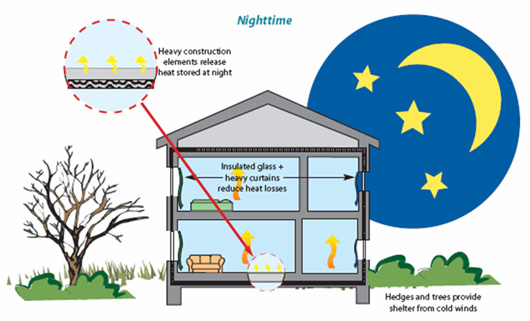
Additional measures like extra insulation (which stores heat during the day and releases heat at night) and high energy performing windows / doors help trap heat and keep the home warm. The types of plants surrounding our home also play a huge part. Shrubbery can be used for shelter and protection against wind. Deciduous trees are also very beneficial because the provide shade in the summer and in the winter months, they lose their leaves meaning that the house is exposed to sun. These additional measures mean that savings can be trebled.


Cooling

In hot, humid climates, Passive Solar Cooling is a great option. So instead of trying to achieve maximum solar potential, the aim is to make a house as cool as possible. Passive cooling uses passive solar design principles to reduce or eliminate your home's need for mechanical cooling systems. By incorporating passive solar design principles into your home's design and landscaping, your home will be naturally comfortable and you will have lower energy bills. The following steps help to keep the house cool.

Orienting your home is important to minimize the amount of sunlight that hits it during the hot summer and to take advantage of the prevailing breezes. In order to keep a house cool, the north facing wall should have the most windows and the south facing wall should only have small windows set high in the wall.

Plant shrubbery around the home for shading. Create pathways throughout the home for natural ventilation. Insulate your home to maintain a comfortable temperature.Have a roof that is lighter in colour, well insulated, and equipped with proper ventilation to exhaust acquired heat. Build an overhang over windows, deep enough to block out the sun in the very hot summer months.


Thank you for taking the time to learn more about renewable energy - Knowledge Is Power! For more information go to www.endeavorscorp.com or write to us at info@endeavorscorp.com if you have questions or want to get involved. Have a green day!