Thursday, 16 February 2012

Hybrids, Flex Fuels, & Initiatives: Your Options For "Going Green" With Vehicles

While walking and biking can work for a lot of individuals, some people still need a vehicle in their daily lives. An environmentally friendly vehicle is one that produces less harmful impacts to the environment than the comparable conventional vehicles. To go green with your vehicle choice consider these technologies:

(See below for a list of some of the top green vehicles today!)

Hybrid Technology

Conserving as much energy as possible, that is built up by the inertia of a moving car, is a major efficiency enjoyed by hybrid cars. This is accomplished through various technologies that are used in concert with a battery to utilize electricity in providing the energy demands of the car. While traditional gasoline is required for a significant portion of the vehicle’s operation, hybrid technologies like the Start-Stop system minimize its use by tapping into electrical power when the car’s needs are modest. Other processes like regenerative braking, take the traditionally discarded energy produced by a slowing car and store it in the battery for future use.

Electric

Quiet and effective at reducing fuel costs, hybrid technology is firmly entrenching itself as a reliable reducer of carbon emissions. The dependence on electric battery technology of specific makes of hybrid cars helps determine each model’s fuel efficiency rating. Recently the use of charging stations at various public places have enabled certain hybrid models, such as Nissan’s Leaf, Volvo’s V70 & Suzuki’s Swift,  to maximize the contribution provided by a car’s battery. Depending on how diligently an owner is with keeping their battery juiced up, some owners are able to get by on one tank of gas a month for their daily commuting needs. Further advancements in hybrid technologies promise to trim the fuel needs of individual automobiles even further in the years to come.

Hydrogen

One promising technology that’s still in the development stage is the use of hydrogen as a propulsion source for automobiles. The explosive capability of hydrogen as fuel offers an alternative energy source that could cater to all of the car’s needs, while emitting only water as a by-product of its consumption. Much like fully electric cars, hydrogen cars need fuelling stations to provide them with ample hydrogen to meet their driving needs. The automotive industry is working hard to modernize hydrogen vehicles so that they are a practical consumer vehicle by 2015.


Flex Fuels

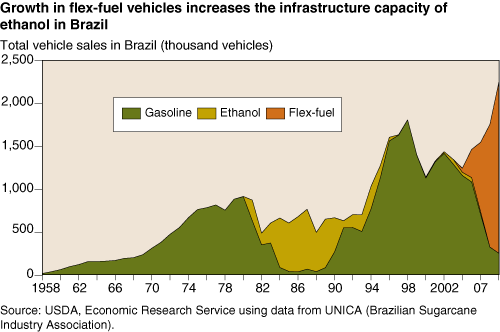
Flex fuels are derived from a mixture of traditional petroleum fuel with plant based ethanol, which greatly diminishes the carbon footprint that trails our global consumption of fuel. The E rating of a flex fuel denotes how much ethanol is in a particular grade of fuel which varies based on the availability of plant-based ethanol and the legal precedent in the region. For example, Brazil leads all countries with a government mandated minimum E20 rating for all commercial gas, while in the United States some corn belt states offer E85 fuel at a lesser cost than typical petroleum based gas.

The introduction of flex fuels into the automobile market has been great for and consumers alike, but there are still obstacles that limit its applicability. Low concentrations of ethanol can be tolerated by most typical car engines but when the content is significantly increased, damage or complete deterioration of the car’s engine can occur. Furthermore, flex fuels with a high ethanol concentration must be heated in cold climates before they can be put to use.

Initiatives

Setting the Tone with Car Share

Founded in Australia’s second most populated city, Melbourne, Green Car Share is implementing one of the world’s most thorough car co-op coverage using an exclusively hybrid fleet of vehicles. Overwhelming support for the program has enabled the company to expand to Sydney and is waiting on approval to bring their service to nine other major Australian cities. Using Toyota’s Prius & Yaris as two of their predominant car share options allows those in the co-op to enjoy a fuel efficiency of under 5L/100km. Green Car Share understands the importance of removing swaths of carbon emissions through combining co-ops with hybrid technology and aims to have an entirely emissions free fleet by the year 2015.

Mass Transport through Hybrid Technology

Trailing only San Francisco as the greenest city in North America, Vancouver, BC, is home to a diverse set of companies that are pioneering methods of mass implementing hybrid technology across the lower mainland. Vancouver & its surrounding suburbs are supplied with its public transportation needs by Translink, a company that began utilizing hybrid technology in 2009 with the introduction of over 140 hybrid buses into their fleet. Employing hybrid technology reduces each bus’ particulate matter emissions to 2.5% of the amount produced by their predecessors. With most of the hybrid fleet serving Vancouver’s central transportation corridor, a significant proportion of the city’s residents are embracing hybrid technology in their daily commute.

Community Foundation Investing in Hybrid Co-Op

Following the lead of Translink, other Vancouver based corporations like the banking institution, Vancity, are investing in hybrid technology. By offering up a few parking spaces at its branches and special sockets that plug in to hybrid electric cars, Vancity’sCommunity Investment Program lends a helping hand to the green local car co-op Modo. Being a non-profit organization which is dedicated to quashing Vancouverite’s carbon emissions enabled Modo to qualify for a grant from the banking institution to help further mobilize hybrid technology. The companies’ collective effort has brought the first electric hybrid car in Western Canada to the car sharing market, serving as a beacon for the global hybrid movement.


Toyota Prius V Plug-in Hybrid

Starting at $32,000       
City Fuel Economy: 2.1L/100km

This vehicle is ideal for people who are primarily travelling short distances at a low speed.  This isn’t to say that the Prius V can’t accommodate long-distance driving or high speed driving, but utilizing the 4.4 kWh battery is optimal in city environments. Requiring about 2.5 – 3 hours to completely charge the battery produces enough energy to drive for approximately 24 kilometers on electricity alone. With impressive cargo space of over 34 cubic feetin this five seat hybrid, the Prius V is the perfect alternative family car.


Lincoln MKZ Hybrid

Starting at $41,400                               
Fuel Economy: 4.6 L/100km

Lincoln is making it easy for consumers to swap towards green energy by offering their MKZ hybrid model at the same price as the traditional model. Combining a 2.5-litre, four cylinder gas engine with a cutting edge electric engine provides customers with all the traditional power they are used to but with a quieter, less intrusive engine. Running on the electric engine alone, the MKZ is capable of reaching speeds of 47mph while assisting drivers with the SmartGauge with Eco Guide to help them optimize their fuel consumption.


Volkswagen Jetta Hybrid
To be released at the end of 2012

The Jetta promises to be one of the most fuel efficient hybrids in the market when it hits the streets at the end of 2012. Offering a 1.4-litre traditional engine that works in concert with a 20 kW electric engine, the Jetta can accommodate everybody’s driving style. With a chic seven-speed DSG dual-clutch transmission, the Jetta is the first of its kind to offer a light-weight automatic transmission vehicle for hybrid enthusiasts.


Honda Insight Hybrid

Starting at $25,295                 
Fuel Economy: 4.8 Litres/100km

The five-door hatchback Insight has comparable specs to other hybrids in its class. It has been on the market since 2009 and can be found for under $20,000 in some economic climates, designating it an ideal choice for budgetary constrained environmentalists world round. The smooth drive provided by the 98 horsepower engine underneath the hood slides in low-emission hybrid technology without impacting its capabilities on the road.


Hyundai Sonata Hybrid

Starting at $28,999
Fuel Economy: 4.6 Litres/100km

Hyundai illustrated its newest technological advancement, “Blue Drive Technology”, with its 2010 release the Sonata. A host of technological advances in the battery, shape, brakes & other areas, help the Sonata competitive with top hybrids in the market, despite its relatively spacious nature. For potential hybrid buyers who want the latest in typical gas-first hybrid technology, Hyundai’s Sonata is a viable option.

Ford Escape Hybrid

Starting at: $23,701                
Fuel Economy: 5.8 Litres/100km

One of the longest established hybrids, the Escape provides a time-tested SUV hybrid option for consumers. While its fuel economy lags behind the competition, drivers of the Escape are impressed by how its power and durability compete with the rest of the compact SUV market. The escape employs a combination of an electric motor with a four-cylinder engine, which help it tackle the diverse environment of a four-wheel drive vehicle. For many green drivers, the Escape provides them with a sizable vehicle that will safely escort them into nature’s back-roads without major greenhouse gas emissions.


Nissan Leaf Electric Hybrid

Starting at $38,395                 
Fuel Economy: 2.2 Litres/100km

Reaching where no hybrid has gone before, the Nissan Leaf’s 80 kW electric engine delivers the opportunity for drivers to eradicate fossil fuels from their transportation equation. Aside from its solely electrical nature,drivers of the Leaf get the most out ofalternative energy technology through features like a solar-panel spoiler on the rear and energy efficient LED lighting throughout the cars frame.  The car’s battery can fuel it for upwards of 70 miles ofdriving, which together with its compact body and ability to comfortably seat five, make it an ideal car for city driving.


Chevy Volt Electric Hybrid

Starting at $31,645                 
Fuel Economy: 2.5 Litres/100km

Unlike the comparable Nissan Leaf, the Chevy Volt provides a more gradual shift towards alternative energy, by endowing drivers with a gas tank to back up the electric motor. A fully charged battery will take drivers around 40 miles in electric mode with any other fuel needs provided by premium fuel, which places the vehicle’s fuel economy solely in the hands of its owners. The vehicle can be completely charged by a typical electrical outlet, making the Volt the most efficient hybrid choice in the market.


All price quotes are taken from corresponding company websites and are based on latest model specifications. For additional information, potential hybrid owners can visit used car dealerships for discounted options.

Thank you for taking the time to learn more about renewable energy - Knowledge Is Power! For more information go to www.endeavorscorp.com or write to us at info@endeavorscorp.com if you have questions or want to get involved. Have a green day! 

Monday, 13 February 2012

Eco-Friendly Flowers

Flowers are a well-known holiday gift and with Valentine's Day just around the corner we encourage you to think green instead of red. There are arguments for all sides of "what's best" in the flower industry but to do your part for the planet, and the people in it, consider local, organic, and fair trade flowers.

LOCAL

Crocosmia - February
Locally-grown flowers can have a significantly reduced carbon footprint by employing a limited amount of harmful emissions to transport them from the garden to the store (as opposed to a large plane ride and more). When making your green flower choice, look for those that are in season at the time of your purchase, as this article shows some flowers grown in a greenhouse can have a greater carbon footprint than those flown for miles.

This website has put together a list of flowers by month to help you make your green flower choice easily: Flowers By Month Be sure to search your local area for what's in season near you!

February

Calendula 
Popular daisy-like flower with a country garden feel 
Safflower 
Unusual slightly thistle like flowers, dries well

Tall spiky flowers generally known as Montbretia when grown as a garden flower.  
Artichoke 
The flower of the artichoke 

Tall flower spikes. Also, Larkspur which is a type of delphinium. 

Daisy like flowers with backward sloping petals. 
Foxtail Lily 
Large dramatic flowers, usually yellow or orange, with other colours less commonly available 
Spurge 
Graceful curving stems with loads of tiny flowers. Note not all colours are available at the same time, check with your florist 

pretty white small flowers, used as a filler 

Exotic looking flowers which hang downwards in a cluster on top of tall straight stems 

Long lasting trumpet shaped flowers up straight stems. 
Pincushion Protea 
Large flowerheads which resemble a pin cushion. Long lasting 
Convallaria 
Tiny bell shaped flowers on short stems. Very popular in wedding flowers. 

A hybrid orchid, with highly patterned petals 

ORGANIC

Much like produce, organic flowers are a great way to cut down on harmful pesticides and other chemicals being released into the environment through farming. Eco Business Links offers a list of some organic growers in North America but be sure to search and ask around for more in your area. Often stores that are not solely organic will also carry some organic products so always look for "Certified Organic" labels to help you identify the right ones.

FAIR TRADE

Fair trade flowers are a great way to do your part for the planet and the people in it; by supporting fair trade, you can help increase the benefits and safety for the workers and reduce the use of harmful chemicals as a benefit for the planet too. Learn more about fair trade flowers and other products here at Fairtrade.ca.

"Flowers are a symbol of celebration, and are popular purchases for occasions like Valentine’s Day, Mother’s Day, or a graduation. But many people admire the beauty of a red rose without thinking about where the cut flower was produced, or under what conditions. 

The Dutch were the first to produce flowers for auction, and began exporting in the early 1600s. Today, half of the world’s flowers are grown in the Netherlands, and Dutch flower auctions amount to 19 million flowers per day. In this multi-billion dollar global industry, developing countries control most of the relevant technology and expertise.

A growing proportion of cut flowers are produced and exported by developing countries such as Kenya, Tanzania, Colombia, and Ecuador. The majority of flowers sold in Canada, available since 2005, are imported from Latin America.

Work in the flower industry is a very important source of income for many people, especially in regions where agriculture no longer brings in a living wage. However, these popular tokens of love and affection are often grown under a labour and chemical- intensive process that puts workers and the environment at high risk. 
Jobs in the flower industry are often insecure, with short-term contracts, low wages, and no benefits. Relatively few workers belong to unions, which would allow them to collectively negotiate better working conditions. Instead, many flower companies work to actively prevent the establishment of unions.
One of the most serious issues in the production of flowers is the exposure of workers, and their environment, to highly toxic chemical pesticides, fungicides, and fertilizers. Flower-importing countries only accept flower shipments if they are totally free of diseases and insects, so the majority of producers use huge quantities of these poisons. 
Workers are often required to handle dangerous chemicals without proper protective equipment. They also experience a variety of serious physical harm due to long hours spent in awkward positions, extreme changes in temperature, and long working hours.
Despite the fact that 65-70% of flower workers are women, they are typically paid less than men and are likely to be hired on a temporary rather than a permanent one. Pregnant and nursing women are often unprotected against exposure to dangerous chemicals.
While this may all sound very unromantic, there's a way to show that special someone that you really care. Go on, flirt with Fair Trade.
Fair Trade aims to protect and benefit workers on flower farms by certifying those farms which ensure safety and good working conditions for their employees. Among other things, Fair Trade standards for flowers ensure the following:
  • Salaries must be equal to or higher than the regional average or the minimum wage.
  • Producer organizations receive a premium, set at 10% of the negotiated price, which is invested in social and economic initiatives.
  • A Joint Body composed of workers and management is formed to manage the Fair Trade premium.
  • Forced labour and child labour of children under 15 years old is prohibited. Children aged 15 and over cannot do work that compromises their health or education.
  • Workers have  the right to establish or join an independent union
  • Health and safety measures must be established in order to avoid work-related injuries. A detailed set of safety regulations specific to flower production limit the use of agrochemicals and prohibit the use of banned pesticides.
If you choose to buy imported flowers, we hope you'll choose Fair Trade. Of course, many flowers are grown in Canada, and you can also find local organic options. Geraniums, poinsettias, chrysanthemums, the Canada Lily (Lilium canadense), and the woodland lily are just a few examples of the flowers cultivated domestically. Fresh local flowers are typically available from May until the middle of October."


Thank you for taking the time to learn more about renewable energy - Knowledge Is Power! For more information go to www.endeavorscorp.com or write to us at info@endeavorscorp.com if you have questions or want to get involved. Have a green day! 

Thursday, 9 February 2012

Solar Energy in the Home

We can all play our individual part in an effort to be greener and this starts in the home. Oil and gas cause pollution and are not an infinite source of energy; we have to look at other options and renewable energy is the way forward. By taking advantage of renewable energy sources like solar energy, we help reduce our carbon footprint as well as save money in the long run. There are a number of solar renewable energy options which can be used around the home for generating electricity, heating/ cooling and hot water.

Paula from Ireland tells us her own experience of using solar heating panels in her own home:

“My parents decided to have solar panels installed into their home after learning that the Irish government was offering grants to encourage people to use renewable energy.  My parents are environmentally conscious but they also saw solar heating as a way of saving money and relying less on commercial energy like oil or gas. Oil was used to heat it the house before but oil prices were getting more expensive. The benefits of solar heating have been extensive, and I have noticed these differences first hand. Ireland has quite a wet climate and so cloudy overcast days are a regular sight. However, water (for the central heating system, showers and sinks) can still be heated even on a dull overcast day. Even if it is only 10 or 15 Degrees Celsius outside, the temperature of the water in the solar panels can be over 45 degrees).
My uncle had done a course on installing solar panels and so the solar panels were set up on our garage roof which is south facing and gets direct sunlight all day. The cylinder for storing the water was also set up in the garage and underground pipes were laid which connect the cylinder to the house.
My parents have noticed a big difference to their oil bill especially throughout the summer months when oil isn’t needed at all. The days are longer and brighter and so reliance on commercial energy was greatly reduced. My parents find that the solar heating provides enough hot water to heat the home as well as provide hot showers for everyone. My parents can also choose when and how they would like to use the warm water. Just think how even more beneficial solar heating would be if you live in a country where there is a lot more annual sunshine and seasons are far less variable! Not only are my parents saving money but they have reduced their reliance on energy like oil or gas which are harmful to the environment and cause global warming. According to the Sustainable Energy Authority of Ireland, active solar heating systems can provide economical hot water and space heating. In Ireland , solar panels can provide around 60% of the annual hot water requirements for homes and buildings. In fact, one square metre receives the equivalent of more than 100 litres of oil in free solar energy per year!

  
Generating Electricity

Photovoltaic (PV) Solar Panels

This is the using solar panels at in the home to generate electricity. It is also known as photovoltaic systems. The amount of power from the sun that reaches the earth at noon on a clear day is about 1,000 Watts per square meter. This is roughly enough power for the electricity needs of a medium sized house. PV systems convert sunlight directly to electricity.

How it works

Solar panels are made from thin layers of semiconductor material, typically silicon. The solar panels work any time the sun is shining. Unlike solar thermal systems for heating water, PV does not use the sun's heat to make electricity. When radiation from the sun shines on this material it generates electrical power. Electronics are then used to adjust the voltage to the correct level. PV allows you to produce electricity—without noise or air pollution—from a clean, renewable resource.


If you generate more power than you use there are two options for what to do with the excess. You can use batteries to store it or, in the UK for example you can sell excess power to the main electricity grid, you will be paid for this.And of course you'll also save money on your electricity bill, because you'll be using your own electricity. This is known as the feed-in tariff.  Wind turbines are also eligible for the UK’s feed-in tariff. In fact, Wind resources are strongest in the winter months, while solar resources are stronger in the summer months, so this means that these two energy sources actually work well together and are often used in hybrid systems.

In warmer countries, the suns energy can actually be used for cooling in homes. Photovoltaic panels can be used to generate electricity to run air conditioning units. During the summer when the sun's intensity is the strongest, it makes sense to harness that power and use it for cooling.

Solar Lighting

A great idea for around your garden is solar lighting. Solar lighting is used for garden lighting, pathway lighting, and architectural lighting as well as for Christmas lighting. For all those who enjoy decorating their homes with Christmas lights, solar Christmas lights would be a great option for next Christmas. There are many perks to solar lighting:

No energy bills so you save money! No wiring so they don’t need a power outlet nearby. No noise or pollution. They are easy to install!


How it works

These solar lights use a mini photovoltaic solar cell which converts solar energy into electricity which is stored in a rechargeable battery. Then at night time, the photo resistor sends out a signal to the controller that it is dark. The controller then routes the power from the battery to the LED in order to turn it on and produce light.

It is important to place solar lighting in locations that receive plenty of sunlight. Lights will also need to be positioned so that the photo resistors aren't near a bright light source in order to make sure the LEDs turn on when the Sun sets.

Heating / Cooling and Hot Water

Solar Thermal Panels

A completely different option is solar thermal panels. These do not generate electricity. Instead, the solar panels heat up the water thus reducing the need to use electricity or gas for heating/ cooling or to heat water. It converts both direct and indirect sunlight into heat so it works even when the sky is overcast. There are two components involved in solar heating: the solar panels and the storage cylinder.

How it works

Cold water is stored in the cylindor and this cold water is then pumped through the solar panels. The sun then heats the solar panels and this heats the water. Then the hot water is pumped back into the tankand then around the home.Hot water naturally rises within the tank so there is no need for pumps
The warm water can then be used for hot water, showers and to heat radiators.

Solar thermal panels can also be used for cooling within the home. Cooling is primarily used in commercial settings, but it is becoming more common in residential homes. There are two applications suitable for residential settings where solar thermal energy is used to drive the cooling process.

Solar Absorption Cooling uses solar-heated water to drive an air conditioner. The air conditioner uses a liquid that consists of an absorbent and a refrigerant. At room temperature these two liquids mix well together. Then solar heat is used to separate the absorbent and the refrigerant from each other. The refrigerant is then compressed and evaporated to create a cooling effect for your home. The evaporated refrigerant is then recombined with the absorbent to go through the process again.

Solar Desiccant Cooling doesn't really cool the air, it removes moisture from the air which decreases the relative humidity. The moisture is removed by passing the air through a material called a desiccant. As the desiccant absorbs the moisture from the air, it becomes saturated and loses its ability to continue absorbing moisture. At this point, the desiccant is then regenerated, or dried, with solar heat which evaporates the moisture into the outside air. It is then ready to absorb more moisture from the air entering your home.


Passive Solar Design for Heating and Cooling

Passive Solar Design is a way of designing a house in orderto minimize or maximize the impact the summer sun has on your home. Passive solar design refers to the orientation and building design of a house.

Summer and Winter

By building a southerly facing house and with the majority of the windows on the south facing wall and the minimum amount on the north facing wall we can maximize solar potential. Keeping non heated or less heated rooms like bathrooms to the back of the house will act like a buffer zone. This means more sunlight and heat, which means less need for lighting and heating. Making these decisions when designing a house can reduce energy bills by 10%.

It is important not to have too many windows though or overheating can occur especially in the spring and summer. Generally, opening windows should be enough to get rid of excess heat in the house. Excess heat gains from the sun can also be avoided by shading windows with blinds or overhangs etc. These overhangs shade the house in the summer months but will allow the sunlight to enter the house in the winter months when the sun is lower in the sky.

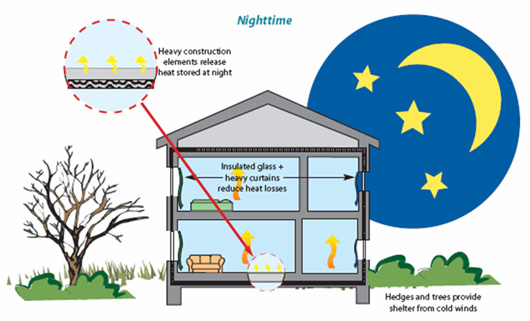
Additional measures like extra insulation (which stores heat during the day and releases heat at night) and high energy performing windows / doors help trap heat and keep the home warm. The types of plants surrounding our home also play a huge part. Shrubbery can be used for shelter and protection against wind. Deciduous trees are also very beneficial because the provide shade in the summer and in the winter months, they lose their leaves meaning that the house is exposed to sun. These additional measures mean that savings can be trebled.


Cooling

In hot, humid climates, Passive Solar Cooling is a great option. So instead of trying to achieve maximum solar potential, the aim is to make a house as cool as possible. Passive cooling uses passive solar design principles to reduce or eliminate your home's need for mechanical cooling systems. By incorporating passive solar design principles into your home's design and landscaping, your home will be naturally comfortable and you will have lower energy bills. The following steps help to keep the house cool.

Orienting your home is important to minimize the amount of sunlight that hits it during the hot summer and to take advantage of the prevailing breezes. In order to keep a house cool, the north facing wall should have the most windows and the south facing wall should only have small windows set high in the wall.

Plant shrubbery around the home for shading. Create pathways throughout the home for natural ventilation. Insulate your home to maintain a comfortable temperature.Have a roof that is lighter in colour, well insulated, and equipped with proper ventilation to exhaust acquired heat. Build an overhang over windows, deep enough to block out the sun in the very hot summer months.


Thank you for taking the time to learn more about renewable energy - Knowledge Is Power! For more information go to www.endeavorscorp.com or write to us at info@endeavorscorp.com if you have questions or want to get involved. Have a green day! 


Thursday, 2 February 2012

UN-Habitat: I'm a City Changer

"I'm a City Changer is a global movement to share and spread individual, corporate, and public initiatives that improve our cities."


Join us as we share our stories and work together to achieve resilient, productive, green cities throughout the globe. 


Share your story today!
"Be the change you wish to see in the world." - Mahatma Gandhi


10 Reasons to be a City Changer:


"21st Century Challenges are in Cities
With over half of the world’s people living in cities, urban areas are the focus point of the impact of rapid urbanization, globalization and climate change.

World Population is growing
Global population in cities will reach 60% by 2030 and 70% by 2050. The number of cities with more than 1 million inhabitants has exploded to over 450, more than 20 of which are ‘megacities’, with a population of more than 10 million.

For No Slums
1 billion people of global population reside in sub-standard housing and informal settlements that lack adequate shelter and basic services. By 2020, an estimated 889 million urbanites across the world will reside in slums and squatter settlements characterized by an absence of any formal urban planning.

For Facing Climate Change
Urban population growth and changing consumption patterns put tremendous pressure on our limited resources. There is mounting evidence of the risks posed by climate change for urban areas and their growing populations which affect water supply, physical infrastructure, transport, ecosystem goods and services, energy provision, industrial production and economies.

For Fewer Emissions
Urban mass concentration entails that cities are consuming most of the worlds’ energy and are responsible for about 70 per cent of total emissions of our planet.

Urban Areas are an Economic Opportunity
Urbanization and urban density brings value. A compact and well-planned city offers businesses a comparative advantage in terms of competitiveness and employment. Poor and disadvantaged persons living in cities are more likely to be lifted out of poverty than their rural counterparts.

Cities are the Future of Younger Generation
Globally, young people aged 15-24 years represent 18 per cent of the world's population. 85 per cent of the world’s young people live in developing countries, where they often comprise a large portion of their communities. An increasing number of young people around the world are growing up in cities – especially in the fast-growing cities of sub-Saharan Africa, Asia and Latin America. In many cities around the continent, more than 50 per cent of inhabitants are under the age of 24.

Cities are Creative and Productive
Cities are the engines of wealth creation and innovation, with the 40 largest urban mega-regions accounting for 66% of global economic activity and 85% of all technological and scientific innovation. Cities capitalize on their economies of agglomeration and scale to deliver opportunities for livelihood generation across all strata of the socio-economic pyramid.

We Love Cities
Cities are the place where our life goes on, our community and where we are related with each other.

It is the Time to Change
If we work together, we can achieve better cities for all. It is the time to start changing; now is the time for City Changers."

Thank you for taking the time to learn more about renewable energy - Knowledge Is Power! For more information go to www.endeavorscorp.com or write to us at info@endeavorscorp.com if you have questions or want to get involved. Have a green day!